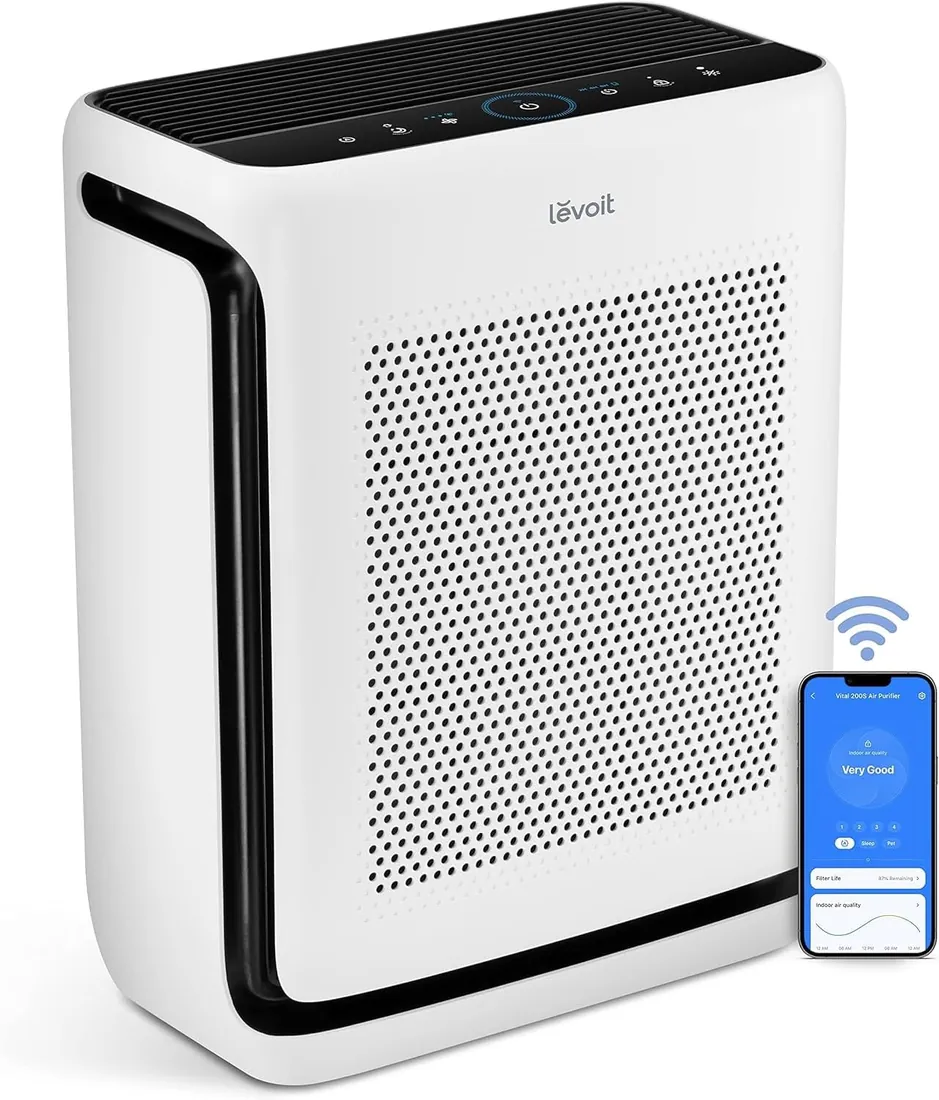
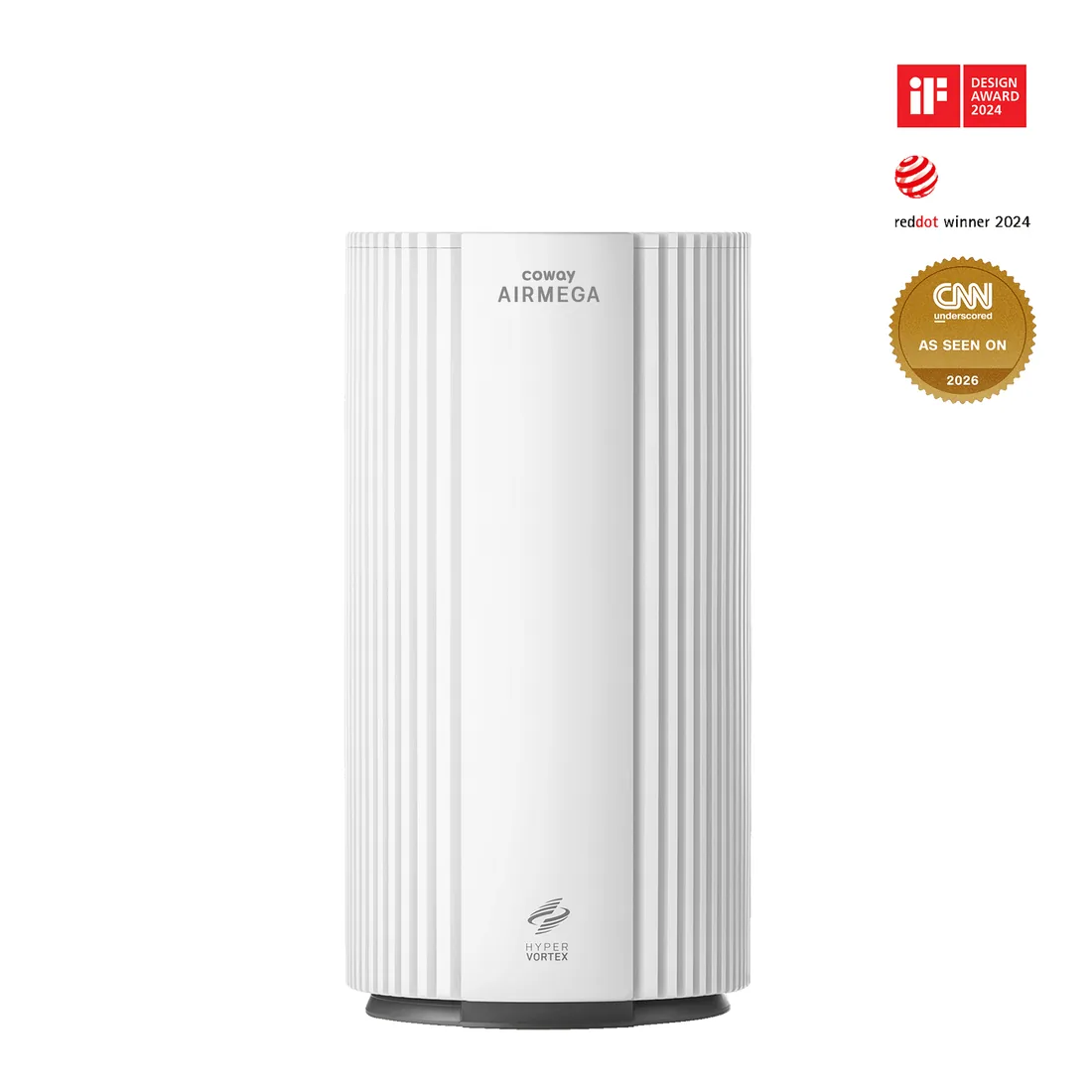
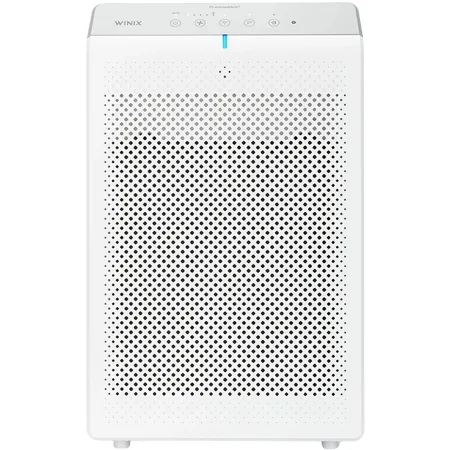
CADR (Clean Air Delivery Rate) is the volume of clean air, in cubic feet per minute, that a portable purifier delivers in a standard lab test. It is measured separately for smoke, dust and pollen; smoke CADR is the most demanding and the most useful. For a room with an 8 ft ceiling, a purifier cleans about CADR × 1.5 square feet at 5 air changes per hour, the level recommended for allergies and smoke.
What CADR measures
CADR comes from the ANSI/AHAM AC-1 test. A purifier runs on its highest setting in a sealed chamber filled with a test pollutant, and particle counters measure how quickly the concentration falls compared with the natural decay of the particles. The result is expressed as an equivalent flow of perfectly clean air in cubic feet per minute (CFM). A smoke CADR of 200 means the purifier removes smoke as fast as if it were supplying 200 CFM of smoke-free air.
That makes CADR the fairest way to compare purifiers: it combines fan speed and filter efficiency in one number. A powerful fan with a leaky filter scores low; a perfect filter with a weak fan also scores low.
Smoke, dust and pollen CADR
| Test | Particle size | Typical CADR ceiling | What it tells you |
|---|---|---|---|
| Tobacco smoke | About 0.1 to 1 micron | 450 | Performance on fine particles: smoke, cooking fumes, PM2.5 |
| Dust | About 0.5 to 3 microns | 400 | Household dust and pet dander |
| Pollen | About 5 to 11 microns | 450 | Large allergens; easiest to remove |
Smoke particles are the hardest to capture and most likely to reach deep into the lungs, so the smoke figure is the one to compare. The test chamber caps the measurable CADR at around 450 for smoke and pollen and 400 for dust, which is why very large purifiers sometimes publish figures above the test limit using extrapolation.
Turning CADR into a room size
AHAM's rule of thumb is a smoke CADR of at least two-thirds of the room's floor area. That works out to about 5 air changes per hour in a room with an 8 ft ceiling, which is what allergy groups and smoke guidance recommend.
| Room | Floor area | Smoke CADR needed |
|---|---|---|
| Small bedroom or dorm | 120 sq ft | 80 |
| Primary bedroom | 200 sq ft | 135 |
| Living room | 300 sq ft | 200 |
| Large living room | 450 sq ft | 300 |
| Open-plan floor | 600 sq ft | 400 |
For a higher ceiling, scale up: a 10 ft ceiling needs 25% more CADR than the table shows. Our air purifier size calculator does the arithmetic.
Why room sizes on boxes disagree
Makers convert CADR into a room size using different assumptions about air changes per hour. The same purifier might be advertised at 360 sq ft (about 4.8 changes per hour) by one listing and nearly 800 sq ft (about 2 changes) by another, or over 1,000 sq ft at one change per hour. When CADR is published, ignore the room size and calculate your own; when it is not, assume the room size is optimistic.
What CADR does not tell you
- Gases and odors: CADR measures particles only. Odor and VOC removal depends on the amount of activated carbon; see how long activated carbon lasts.
- Noise: high CADR on the top speed may come with 50 dB or more.
- Running cost: filter price and replacement interval matter as much as purchase price; see filter cost per year.
- Filter loading: CADR is measured with a new filter and falls as the filter loads.